
Please note that I use Amazon associate links in all the links in this article. That means I’ll get a commission on anything you end up purchasing.
As the owner of multiple software companies, I understand the importance of engaging users and driving behavior change to create successful products. That’s why when my Head of Product and I came across “Actionable Gamification” by Yu-kai Chou, it was a game-changer for our approach to product development. This book not only provided valuable insights into the psychology of human motivation but also inspired us to create a gamification framework that we now use with each of our projects.

- Hardcover Book
- Chou, Yu-Kai (Author)
- English (Publication Language)
- 514 Pages – 04/01/2017 (Publication Date) – Yu-Kai Chou (Publisher)
Chou’s book goes beyond the superficial aspects of gamification, such as points, badges, and leaderboards, to explore the deeper principles of human motivation and engagement. Drawing on his extensive experience as a gamification expert and consultant, Chou introduces the Octalysis Framework, a powerful tool for understanding and designing engaging experiences.
One of the most compelling aspects of “Actionable Gamification” is its emphasis on the eight core drives of motivation that underpin human behavior. Chou breaks down these core drives, ranging from accomplishment and empowerment to social influence and unpredictability, and explains how they can be leveraged to design experiences that captivate and motivate users.
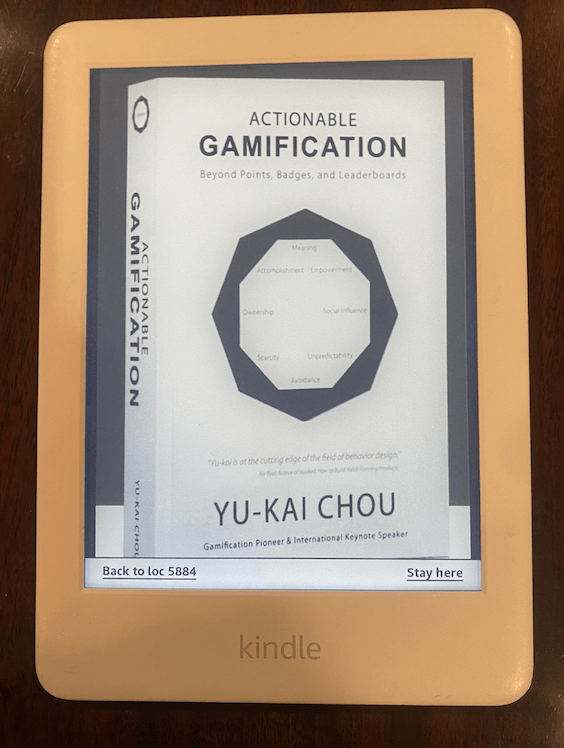
For my team and me, the Octalysis Framework provided a powerful lens through which to analyze our products and identify opportunities for improvement. By mapping out the core drives at play in each project, we were able to tailor our gamification strategies to better align with our users’ motivations and goals.
Moreover, “Actionable Gamification” offers practical guidance on how to implement gamification principles effectively in product design. Chou provides concrete examples and case studies that illustrate how companies like Nike, Duolingo, and Dropbox have successfully applied gamification techniques to enhance user engagement and drive desired behaviors.
One of the most significant impacts of “Actionable Gamification” on our product development process was its emphasis on user-centered design. Chou argues that effective gamification requires a deep understanding of your users’ desires, preferences, and pain points. Armed with this insight, we were able to design experiences that not only delighted our users but also drove meaningful outcomes for our business.
In addition to its practical insights, “Actionable Gamification” challenged us to think differently about how we approach product development. Rather than viewing gamification as a superficial layer added on top of a product, Chou encourages us to integrate gamification principles into the core of our user experience. By embedding elements of play, challenge, and reward into the fabric of our products, we were able to create experiences that were not only engaging but also inherently motivating.
Final Thoughts
In conclusion, “Actionable Gamification” by Yu-kai Chou has had a profound impact on our approach to product development. Through its insightful analysis, practical guidance, and inspiring examples, this book has empowered us to create products that not only meet the needs of our users but also inspire them to take action and achieve their goals. Whether you’re a seasoned product developer or just starting out, “Actionable Gamification” offers valuable insights and practical techniques for designing engaging and impactful experiences that drive user behavior.